LOCKING ETIQUETTE
May 29, 2016
By John Gullick, Manager of Government and Special Programs
These notes on how to lock through are taken from the Canadian Power and Sail Squadron’s Basic Boating Course.
Where there is a considerable difference in water levels between adjacent sections of a river or canal, locks are used to move boats from one level to another.
A conventional lock is a watertight chamber with a watertight gate at each end. If the valves in the lower gate are opened and those in the upper gate remain closed, the water runs out. Boats inside the lock are thereby lowered. When the valves in the lower gate are closed and those in the upper one are opened, the lock fills with water and boats are raised.
There is a different type of lock in which the boats enter a chamber which is like a large bathtub. The chamber is then raised or lowered to carry the boat to a higher or lower level. Although a lift lock is mechanically different from a normal lock, the procedures to be undertaken by boaters are the same.
Lockmasters and attendants are responsible for the safe passage of boats through the locks. Their instructions must be obeyed. These instructions may be conveyed by voice, lights, hand signal or VHF radio.
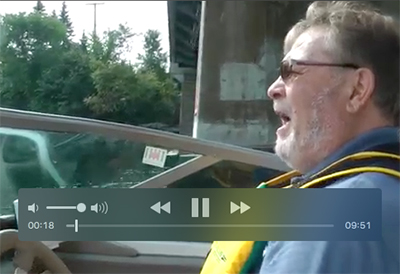
{videobox}imagIXQhIO0{/videobox}
A red light means that the lock cannot be entered. Boats wishing to pass through must wait at the designated waiting area. In many cases this area is indicated by a prominent blue line painted on the wall close to the lock.
A flashing red light means that the lock is being operated. Boats should keep clear of the lock but get ready to enter.
A green light means the boat can enter the lock slowly and with caution.
In order to lock through quickly and safely, the boat operator must know what is expected and be prepared to do as they are instructed by the lockmaster. For this reason a copy of the Canal Regulations should be carried on board. This is particularly important on busy weekends when a dozen or more boats may be locking through the same lock at the same time.
Before entering the lock, fenders should be hung on both sides of the boat. Lines must be available at both sides of the stern and at the bow. Lockmasters generally give specific instructions and will usually instruct large boats to enter first. The lock must be entered slowly to avoid carrying the boat’s wake into the lock.
The tops of the lock walls are fitted with bollards, posts or rings for temporarily securing the boat. In many locks, chains or cables are hung down the walls. Lines from the boat should be passed around these. The lines will slide up or down as the boat rises or falls. In some locks on the Seaway and Sault Ste. Marie, attendants pass a pair of lines to boaters. In other locks (American locks on the Seaway) small boats put a line around a floating bollard that moves up or down as the lock is filled or emptied.
To avoid fire or explosion all engines must be shut off, all flames must be extinguished and there must be no smoking once the boat is in the lock and secured.
NOTE: Never tie a boat securely to a bollard, ring, cable or chain in the lock, because there is danger of capsizing as the water level changes.
Before leaving the lock, blowers must be switched on for at least four minutes before restarting the engine. In many locks you will be asked to leave the blower on all the time which is always a good idea. The lockmaster indicates the order in which boats are to leave and they must do so at low speed.
NOTE: Where there is only a short distance between locks, boats are locked through in groups, and the lockmasters notify one another. Nothing is gained by speeding between locks. It simply means a longer wait at the next lock.
For more information about this and other courses go to www.boatingcourses.ca