TALBOT CANAL CONCRETE REHABILITATION
Feb 13, 2017
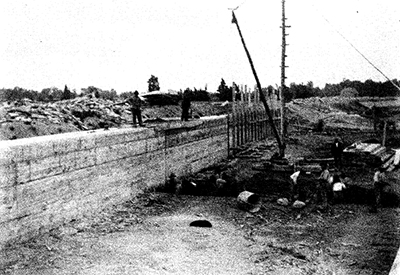
Talbot canal under construction
Gamebridge, City of Kawartha Lakes; Trent-Severn Waterway National Historic Site
The Trent-Severn Waterway is an historic transportation route from Lake Ontario at the Bay of Quinte to Georgian Bay on Lake Huron, which has evolved into the lakes, locks, rivers and canals that we recognize today. It continues to connect communities and people, and provide opportunities for recreation and economic benefit while also providing habitat for aquatic and terrestrial species.
One of the gems of the Trent-Severn Waterway is the three little locks in a row that connect Canal lake to Lake Simcoe; Locks 39 -41 on the Talbot Canal. This section of the Trent-Severn Waterway was built between 1895 and 1907, at the same time as the Kirkfield Lift Lock. The locks here are operated in much the same way as they originally did, and this representation of original canal construction and operation has been recognized for its national historic significance.
As a part of an historic investment into Trent-Severn Waterway infrastructure, the Talbot area will see considerable construction activity in the coming years. The scale of the work necessitates an aggressive schedule, including extended work hours, in order to complete the work and maintain the navigation season from late May to early October.
Residents and visitors will have already seen activity in the Talbot area. Parks Canada staff have been removing vegetation from along the earth dams in the area to increase their stability for years to come. A construction trailer has been stationed at Lock 38, which will be used as a workspace for the oversight of work in the entire Talbot area. Finally, geotechnical work that will provide important information about the composition and integrity of soils and concrete will now begin at the dam at Lock 38, the Talbot dam, and the earth dams between Lock 39 – 41. There are many ways of obtaining this geotechnical information: test pits dug with an excavator, boreholes in earth or rock using drill rig and auger, concrete core sampling with a smaller drillrig or portable system, or even seizmic sounding line. All of these methods may be used in this area.
Major concrete repair work will take place on the Talbot canal between Lock 39 and Lock 41, and contractors will mobilize to the sites in the weeks to come. Work will be comprised of removing and re-facing the existing concrete walls of each lock and approach wall in an effort to reinstate the locks to their originally constructed appearance, while improving their condition. In addition, steel components that are embedded in the concrete at each site will be cleaned and painted. The work at Locks 39 – 41 will be completed in several phases, with most phases being completed before the navigation season begins in May, 2017, Canada’s sesquicentennial year. The scale of work being completed in the Talbot area necessitates an aggressive schedule for the concrete work at Locks 39 – 41, with both a daytime and a nighttime shift being utilized. Work lights will be used at each site to allow the contractors to work through the night.
How to stay informed:
For information about this or other infrastructure projects in your area, please visit www.pc.gc.ca/tswTalbotSimcoe or www.pc.gc.ca/tswInfrastructure For questions or concerns, or to receive email updates regarding this project, please contact us at Ont.TrentSevern@pc.gc.ca and include “Talbot Area” in the subject heading. Or, stay up-to-date on construction projects, boating activities and events, and general canal-i-pedia by following our social media channels: twitter: @trentsevernnhs, Facebook: /trentsevernnhs