First hydrogen-powered RIB hits the water
July 31, 2023
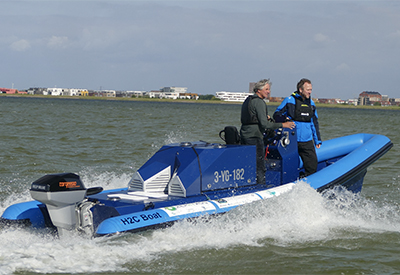
This summer, the world of competitive sailing is set to witness an historic moment as the Dutch sailing organization Watersportverbond introduces their first-ever emission-free, hydrogen-powered coach boat, the H2C Boat, at the 2023 World Sailing Championships in The Hague, Netherlands. The H2C Boat, equipped with a Torqeedo Deep Blue electric motor, revolutionizes the sailing community and paves the way towards a more sustainable and environmentally friendly era.
The H2C Boat, developed by the Dutch start-up H2 Marine Solutions, represents the collective efforts of a consortium of innovative companies, including longtime Torqeedo partner De Stille Boot and the Delft University of Technology (TU Delft). Torqeedo played a vital role in supporting the project from inception, providing the powerful Deep Blue 50R outboard motor and Deep Blue 40 lithium-ion battery, as well as contributing to the crucial energy management system.
Powered by a 40 kWh Deep Blue battery and an additional 51 kWh hydrogen capacity, the H2C Boat utilizes a hydrogen fuel cell as a range extender, ensuring a minimum of five hours of operation on the water. This revolutionary vessel, measuring six meters in length and capable of reaching a top speed of 45 km/h, offers a silent and emissions-free alternative to conventional coach boats, making it the ideal companion for athletes during their training and competitions.
Fabian Bez, CEO of Torqeedo, stated, “Sailing is all about harnessing the power of nature, wind, and waves. Now, the highest levels of competitive sailing can achieve the range, runtime and performance they need in a coach boat, emission-free.”
Torqeedo has been at the forefront of developing cutting-edge solutions for electrification in the maritime sector, and their collaboration with H2 Marine Solutions marks a significant milestone in the quest for greener marine transportation.
Marcel Schaap, founder and managing director of De Stille Boot, emphasized the broader impact of the H2C Boat project, saying, “The presence of hundreds of coach boats at the World Championships showcases the potential of this project in reducing the carbon footprint of sailing events.” As the sailing community sets new sustainability goals, the use of zero-emission coach boats at major regattas by 2030 becomes a reality.
The H2C Boat project, which began with an idea from Dutch Olympic sailing coach Jaap Zielhuis during the 2018 World Championships in Denmark, exemplifies the collaborative spirit that drives innovation. The partnership between the Sailing Innovation Centre, Watersportverbond, TU Delft, De Stille Boot, Intelligent Energy, Hyfly, Koedood Marine Group, and Habbeké Shipyard has resulted in a groundbreaking success story. The development was also part of the Zephyr project, which aims to demonstrate the technical viability of a green hydrogen chain in the maritime sector in the Netherlands. This project encompasses the entire process from the generation of green power to its application in vessels, with the ultimate goal of achieving zero emissions.
Torqeedo CEO Fabian Bez remarked on the company’s commitment to future developments, saying, “Fuel cell technology in the maritime sector is still evolving. As pioneers in electrification, we have designed our electric drive systems to leverage sustainable energy, from solar and wind power to fuel cells powered by hydrogen or other carbon-neutral liquid fuels.”
As the H2C Boat makes its debut at the World Sailing Championships, the sailing community takes a giant leap towards a sustainable and emission-free future. The event not only celebrates sporting excellence but also represents a pivotal moment in the effort to protect our climate and local air quality. By embracing innovative technologies and working together, the sailing community, together with Torqeedo, is demonstrating its potential to inspire change.