VOLVO PENTA LAUNCHES INDUSTRY’S FIRST FULLY INTEGRATED ASSISTED DOCKING SYSTEM AT CES
Jan 19, 2021
Volvo Penta has announced the commercial availability of the industry’s first fully integrated Assisted Docking system against the backdrop of the Consumer Electronics Show (CES). The Assisted Docking system gives the captain better control when docking a boat by automating his or her intentions, compensating for some dynamic variables, such as wind and current, and helping the vessel stay on its intended course. The technology was on display at Volvo Penta’s virtual booth at CES from 11-14 January 2021.
Docking can be one of the most stressful and challenging aspects of boating – even for experienced captains. The consequences of getting it wrong when you are docking a boat are expensive, at best – and that is in fair weather. Add crowded marinas, strong winds, and rough currents and the outcome can be problematic and even quite dangerous. Unlike a car, a boat never stands still without some maneuvering required. And moving in a straight line, into a narrow berth in foul weather is much more difficult than steering the wheel of a car. But Volvo Penta has now taken its joystick-docking technology and easy boating solutions to the next level in its continued efforts to make docking a less stressful endeavor.
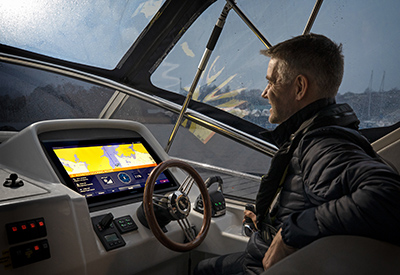
The Assisted Docking system integrates a software layer developed in house with the company’s GPS-based Dynamic Positioning System and proprietary Inboard Performance Systems (IPS) for a complete package including HMI (human-machine interface) at the helm, electronics via the engine, propulsion systems and sensors, and advanced navigation processing power for a much easier boating experience, even in rough conditions.
“When we launched our joystick technology in 2006, the maneuvering and control functionality it brought to leisure boating shook up the marine industry – delivering game-changing innovation is in our DNA,” explains Anders Thorin, Product Manager Electronics at Volvo Penta. “From our Electronic Vessel Control (EVC) system, which connects and manages the internal communications between the engine and driveline, joystick and display screen so the driver can control everything from the joystick – to our Dynamic Positioning System (DPS), which automatically maintains a boat’s heading and position, even in rough conditions – to today with the release of the Assisted Docking system, we take the next step in easy boating and continue our long-held ambition to make docking a boat easier for a more enjoyable boating experience.”
How to dock a boat with Volvo Penta’s Assisted Docking system
The Assisted Docking system consists of the joystick that controls the steering input and the GPS-based Dynamic Positioning System antenna to know the exact position and heading. The captain maneuvers the vessel with the joystick – thereby informing the system which direction it should head in and at what speed. If you move the joystick forward, the system lays out a path straight forward from the boat and the boat starts to follow a straight line with the indicated speed. The boat docking system also takes into account certain external forces (i.e. wind, current) and the EVC system – upgraded with in-house developed software – compensates to ensure the boat follows the captain’s intentions. It does this by calculating drive angles and thrust, then acts on the drift and moves the boat back to its intended course. The boat docking system keeps this course by constantly fine-tuning the steering angles and thrust.
The main features of the boat docking system are: moving in straight lines without manual compensation, standing still, slow maneuvering functionality, rotating around a fixed point, micro re-positioning and alignment, and side push for sideways docking.
It is a technical feat to give the driver an easier boating experience with more precise steering and control. The captain is still needed at the helm, but Volvo Penta’s Assisted Docking system is constantly compensating for engine input and engine and drive output to help ensure the boat moves as he or she intends. Everything is designed to work together. It is human-machine interaction at its best.
Visit: www.volvopenta.com