Communicating with your boaters on fuel and end-of-life boats
Andy Adams

Apr 20, 2021

As we come to the start of the season, we have a very timely story from NMMA Canada who is alerting us to the fact that we are likely to see E15 level fuel in the Canadian market this summer. Any marine technician will tell you that running E 10 can be damaging to marine engines and other machines like lawnmowers, chainsaws and snow machines.
 
This would be a good time to communicate with your customers to explain why purchasing ethanol-free marine fuel from a reputable Marina is an important decision, especially from a safety perspective. Non-marine fuel can cause an engine problem that could leave boaters stranded and in danger unexpectedly. 
 
Understandably, gasoline is more expensive in a Marina because the Marina operator goes to a lot of trouble to get ethanol-free gasoline and because the Marina probably only sells a small quantity of gasoline compared to the year-round sales at a roadway gas station. It’s important to explain why Marina pricing may be significantly higher. Many boat owners will use fuel that they’ve purchased from a roadway gas station not understanding the difference.
 
Another subject that boaters are probably not familiar with, is the whole issue of end-of-life boats, abandoned boats and boats that need to be recycled. My son shared the image below with me this week. It was something he found on the Internet. Obviously, this is the wrong way to dispose of an old boat, but it reminds us to tell our customers what their obligations are as boat owners, to either sell or responsibly dispose of a boat it’s no longer wanted. It can’t just go into the bin!
 
Hopefully, these two points help the marinas to sell more fuel this summer and to get ahead of the issue of end-of-life boats.

Andy Adams – Editor
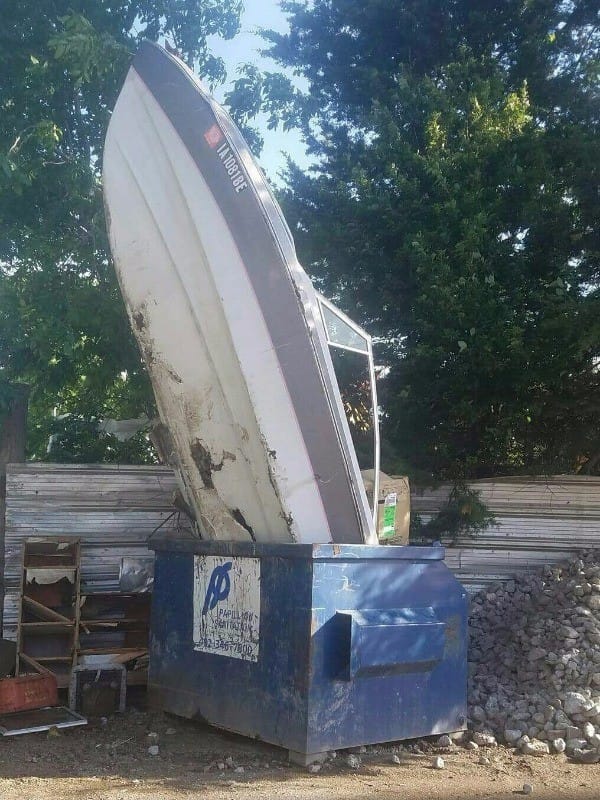
Dumpster Boat

Related Posts


Good Advice that You Can Share – The Art of Anchoring  

Unless a boat is secured, it will drift away. If it cannot be attached to something secure, such as a dock, piling, mooring buoy, tree, or boulder, it must be anchored. There is much more to anchoring than simply tossing the anchor over the side. 
 
An anchoring system has two parts: the anchor itself and the rode which connects the anchor to the boat. To be effective, an anchor must have good holding power, and the rode must be strong enough to withstand the strains that are put on it. 

Read More


Need to Catch up on News This Week?

Every Tuesday we publish a fresh Digest with informative articles pertaining to the Canadian boating and marine industry. Stay up to date with the latest products, research and industry developments.

Missed an Issue of Boating Industry Canada News Week? If you’re looking for a specific issue, or simply want to catch up on previous issues, check out our Boating Industry Canada News Week Archives.

Not signed up for News Week? Subscribe here.


Rayglass 2400 makes its Australian debut at the 2026 Sydney Boat Show

Rayglass Boats, a Brunswick Corporation (NYSE: BC) brand and a globally recognized designer and manufacturer of premium power boats, today announced that Australian boaters will get their first chance to see the Rayglass 2400 it in person for the first time. Queensland Marine Centre will bring the 2400 to the 2026 Sydney Boat Show, running 30 July – 2 August at Sydney Showgrounds, Sydney Olympic Park at Stand D104. The next generation 2700 will also be on display.

Read More


ePropulsion Enters Powered Kayak Fishing Market with Innovative kLite Electric Outboard

ePropulsion Americas, the global leader in marine electric propulsion systems and services, has announced that it is entering the powered kayak market with the all-new kLite 750 electric outboard. Building on the award-winning technology that shattered convention with the highly portable eLite, the kLite 750 is powerful, but contained in a lightweight and compact form factor ideal for recreational or fishing kayaks alike.

Read More