USB receptacles keep phones and tablets charged at sea
Hubbell USB Receptacles

Mar 21, 2022

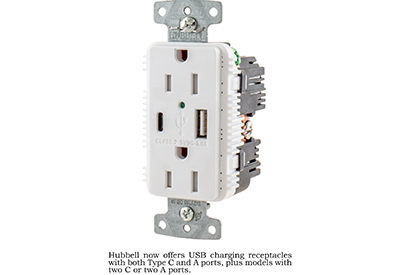
With both boats and boaters having become more connected than ever, there’s never been greater need to keep portable devices fully charged while underway. USB Charger Receptacles from Hubbell Marine include USB Type A or Type C ports within a traditional duplex outlet for the neatest possible installations and unbeatable convenience.

Hubbell offers a choice of three styles: two Type A USB ports, two Type C or one of each, all in combination with two standard three-prong outlets. These duplex receptacles deliver 5A and 5 volts of power to charge two devices simultaneously on the USB ports while retaining everyday usability with standard electrical devices. All comply with battery charging specification BC1.2 and are fully compatible with USB 1.1/2.0/3.0 devices, including Apple® products.

The USB ports are constructed with durable stainless steel and rated for 10,000 plug insertions and removals. They feature an integrated LED that confirms USB and line voltage power availability. A choice of ivory, white or light almond finishes allow the receptacles to work with a wide range of interior décors, either in new build or retrofit applications. Black, brown or gray finishes are available as special orders.

For outdoor spaces like boat cockpits and flybridges, Hubbell also offers a Weather Resistant USB Charger Receptacle in the combination Type A and Type C configuration. It incorporates a green LED power indicator and comes in either 15A or 20A versions in white, almond or ivory. Weather resistant models are fully compliant with section 406.9 of the National Electrical Code when used with covers.

Suggested retail prices for Hubbell Marine standard USB Charger Receptacles (USB15 series part numbers) start at $55.10 USD. The Weather Resistant models (USB15 and USB20 series part numbers) start at $60.15 USD.
www.hubbell-marine.com.

Related Posts


Good Advice that You Can Share – The Art of Anchoring  

Unless a boat is secured, it will drift away. If it cannot be attached to something secure, such as a dock, piling, mooring buoy, tree, or boulder, it must be anchored. There is much more to anchoring than simply tossing the anchor over the side. 
 
An anchoring system has two parts: the anchor itself and the rode which connects the anchor to the boat. To be effective, an anchor must have good holding power, and the rode must be strong enough to withstand the strains that are put on it. 

Read More


Need to Catch up on News This Week?

Every Tuesday we publish a fresh Digest with informative articles pertaining to the Canadian boating and marine industry. Stay up to date with the latest products, research and industry developments.

Missed an Issue of Boating Industry Canada News Week? If you’re looking for a specific issue, or simply want to catch up on previous issues, check out our Boating Industry Canada News Week Archives.

Not signed up for News Week? Subscribe here.


Rayglass 2400 makes its Australian debut at the 2026 Sydney Boat Show

Rayglass Boats, a Brunswick Corporation (NYSE: BC) brand and a globally recognized designer and manufacturer of premium power boats, today announced that Australian boaters will get their first chance to see the Rayglass 2400 it in person for the first time. Queensland Marine Centre will bring the 2400 to the 2026 Sydney Boat Show, running 30 July – 2 August at Sydney Showgrounds, Sydney Olympic Park at Stand D104. The next generation 2700 will also be on display.

Read More


ePropulsion Enters Powered Kayak Fishing Market with Innovative kLite Electric Outboard

ePropulsion Americas, the global leader in marine electric propulsion systems and services, has announced that it is entering the powered kayak market with the all-new kLite 750 electric outboard. Building on the award-winning technology that shattered convention with the highly portable eLite, the kLite 750 is powerful, but contained in a lightweight and compact form factor ideal for recreational or fishing kayaks alike.

Read More