MEASURING CORROSION ON BOATS AND OTHER MARINE STRUCTURES
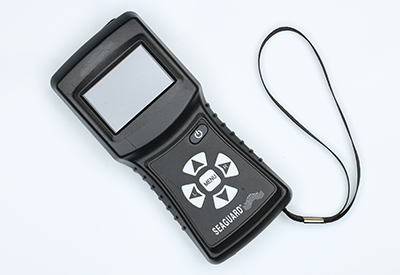
Seaguard Corrosion Tester


Feb 6, 2018

Detecting the threat of electrolysis and corrosion is an important step for any owner.

Vessels in seawater produce galvanic reactions that cause corrosion of metals. A metal’s natural electrical potential will flow through the hull when the hull contains different metals. The most active metal discharges electrical current to the other metal, cycling the current back through the seawater causing the most active metal to corrode.

To combat this natural corrosion, the hulls and structures in seawater will have sacrificial metals attached to them such as Zinc or Aluminum. By attaching these metals to the metallic structure or hull, the sacrificial metal becomes the anode and the structure or hull becomes a cathode which cannot corrode while the anode is in place. Once installed the anode will corrode, consume and lose metal over time which is why this corrosion protection system on a boat should be checked at regular intervals. Failure to do so can lead to loss of corrosion protection resulting in a costly and time-consuming repair.

The Seaguard Digital Corrosion Tester is a high-impedance voltage meter with a reference cell. The tester is specially designed to check the electrical potential of the hull at different locations on the hull while the boat is in seawater. Each reading is color-coded to indicate whether the boat is protected, under-protected, or overprotected.

The hand-held tester is easy to use with a quick response time. It also has quick release lock connectors for both the reference cell and the alligator clip to ensure you will never lose it. It is available in STANDARD model for Zinc reference cell (ZRE) or choose the PROFESSIONAL model for Silver and Silver Chloride (SSC) reference cell.

Visit Canada Metal Pacific Seaguard brand at: www.seaguardinternational.com
Related Posts


Good Advice that You Can Share – The Art of Anchoring  

Unless a boat is secured, it will drift away. If it cannot be attached to something secure, such as a dock, piling, mooring buoy, tree, or boulder, it must be anchored. There is much more to anchoring than simply tossing the anchor over the side. 
 
An anchoring system has two parts: the anchor itself and the rode which connects the anchor to the boat. To be effective, an anchor must have good holding power, and the rode must be strong enough to withstand the strains that are put on it. 

Read More


Need to Catch up on News This Week?

Every Tuesday we publish a fresh Digest with informative articles pertaining to the Canadian boating and marine industry. Stay up to date with the latest products, research and industry developments.

Missed an Issue of Boating Industry Canada News Week? If you’re looking for a specific issue, or simply want to catch up on previous issues, check out our Boating Industry Canada News Week Archives.

Not signed up for News Week? Subscribe here.


Rayglass 2400 makes its Australian debut at the 2026 Sydney Boat Show

Rayglass Boats, a Brunswick Corporation (NYSE: BC) brand and a globally recognized designer and manufacturer of premium power boats, today announced that Australian boaters will get their first chance to see the Rayglass 2400 it in person for the first time. Queensland Marine Centre will bring the 2400 to the 2026 Sydney Boat Show, running 30 July – 2 August at Sydney Showgrounds, Sydney Olympic Park at Stand D104. The next generation 2700 will also be on display.

Read More


ePropulsion Enters Powered Kayak Fishing Market with Innovative kLite Electric Outboard

ePropulsion Americas, the global leader in marine electric propulsion systems and services, has announced that it is entering the powered kayak market with the all-new kLite 750 electric outboard. Building on the award-winning technology that shattered convention with the highly portable eLite, the kLite 750 is powerful, but contained in a lightweight and compact form factor ideal for recreational or fishing kayaks alike.

Read More