Boat for breakfast? Fibreglass on the menu along UK’s southern coast
July 16, 2024
The following story follows up the article published in the July 3rd edition of Marine Industry News from the UK that was re-published with permission in the July 9th edition of Boating Industry Canada News Week Digest. This story ran in the July 5th edition of Marine Industry News from the UK. – Andy Adams – Editor – Boating Industry Canada News Week Digest
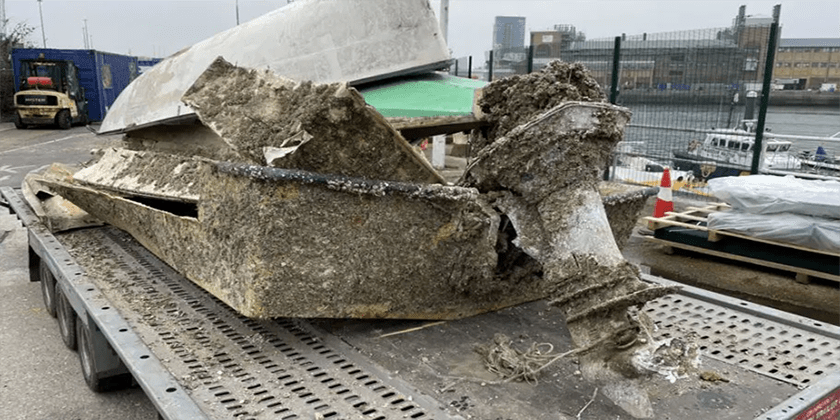
The marine industry is bracing itself for an outcry as mainstream media outlets, like Sky, pick up the story that MIN reported last week. Specifically, a ‘disturbing level’ of fibreglass has been found in oysters and mussels. The public spotlight is firmly on end-of-life vessels. Dumped boats. And what the marine sector is doing about them being abandoned into the human food chain.
MIN has been advocating for change with end-of-life vessels for years, alongside Boatbreakers, a marine salvage and recyling yard, based in Gosport UK. Luke Edney, manager, reckons that anyone eating seafood in Gosport and Portsmouth has been unknowingly ingesting fibreglass for a while.
“If you’re eating locally caught seafood, you’re also eating the local abandoned boats.”
Luke Edney
“This is why it’s important for local authorities, harbour masters and owners to remove GRP abandoned wrecks to stop them making their way into the surrounding environment and ultimately the food chain.”
Edney has been involved in the research project run jointly by the Universities of Brighton and Portsmouth. That detected GRP particles in the soft tissues of oysters and mussels collected near an active boatyard in Chichester Harbour, a popular sailing destination in south England.
When Edney saw Dr Corina Ciocan on Countryfile a few years ago, he got in touch to see if he could help with her project, and ended up sending her ‘some bits of old boats for them to test’.
Fibreglass boats can disintegrate into food chain
“Boats ending up in a landfill is the lesser of two evils until there is a solution for this,” Edney says. When old wooden boats are dumped in the water, they rot away. “But fibreglass disintegrates and leeches into everything else. That’s why you can’t just sink them.”
Robert Parton, new president of British Marine, calls himself a ‘realistic tree hugger’ but says what to do with end-of-life vessels “is a huge issue. I don’t know what the answer is. It isn’t like paper where you can recycle and reuse. There’s no natural place for it [GRP].” He believes that any actions – like having a boat tax up-front to pay for recycling at a boat’s end – needs to be European or universally wide, otherwise they’ll never work. People will buy boats from other countries to avoid taxes, he says.
“Ultimately it’s the boat owner – the one who owns it now – that has to pay the cost,” Parton says. “There becomes a point where the old boat isn’t worth anything and it [recycling] becomes a cost.”
Calls for national boat register to avoid dumping GRP into water
A national boat register would help with this, allowing boats which have been dumped to be traced back to their last owner. “There comes a point where owners just walk away. Canal boats aren’t as bad because they’re made of steel which is more recyclable. . . in theory . . . but they’ve got furnishing and fittings inside them. And the value of the steel as scrap doesn’t get anywhere near the cost of disposing of the boat. It’s part of an ongoing battle. No one’s got the answer yet.
“We need a scrappage scheme like we had for cars a few years ago. That was great because it cleared up all that stuff that was worth a few quid, and people took their £1000 and got a better car. If we could create that . . . but someone has to pay for that, don’t they?”
Robert Parton
Investment is one of Parton’s key topics for a new government to consider.
“It’d be nice to help to find an answer. To make the current cruising fleet more sustainable and low carbon with better fuels is achievable, but getting rid of these old boats is a bigger pill to swallow.”