Flag Etiquette – How to Fly Flags and Pennants
October 20, 2026
By John Gullick
I am starting with a couple of questions that I have received regarding flag etiquette.
Can I fly a blue ensign flag on my recreational vessel?
The Blue Ensign was a Canadian Navy flag that was flown before the new Canadian flag was introduced. Ensigns were designated for official Department of National Defense navy vessels, so are not for use on recreational vessels. That would be inappropriate.
I also received an e mail from a Canadian who owned and operated a classic cruiser in the U.S. The boat, for the most part, stayed in U.S. waters and was licensed in a U.S. State. The owner wanted to know where he could fly a Canadian flag to indicate his citizenship.
The simple answer was that he could not if he was operating in U.S. waters. The National flag indicates the Country of registry or where the boat is licensed, in this case the U.S.
A courtesy flag indicates where the vessel is being operated, for the most part, also the U.S. These flags do not indicate the citizenship of the owner/operator.
However, I did advise that when a foreign guest is aboard, you can display the guest’s country flag from the bow staff or port spreader halyard.
Moving on:
Flags and pennants tell a story to those who observe them, so a code of conduct or etiquette has been developed over the years to determine how flags and pennants should be properly flown. This code was originally developed for large commercial or naval vessels but has been modified and is flexible enough to accommodate the construction and configuration of most modern pleasure craft.
Here are a few key points to remember and follow:
Order of Importance, sometimes referred to as the “Points of Honor”:
- the gaff, if the vessel is equipped with one
- the flagstaff at the stern
- the bow staff
- the starboard halyard just below the spreader
- the mast head
- the port halyard just below the spreader
When locating the points of honor on your boat you must remember that the flag of highest importance does not always go to the highest point of honor. It can only be flown at the highest point of honor that it is entitled to.
The highest point of honor is always reserved for the national flag. If the national flag is not flown its point of honor or position should remain vacant. A club burgee, for example, cannot replace it. That burgee must remain at its point of honor.
Various flags and their normal points of honor:
The Canadian Flag should be flown from 0800 until sunset or at all times when the vessel is underway, weather and rig permitting. The Canadian flag should be lowered if you leave the vessel when you are in port and will not return until after sunset.
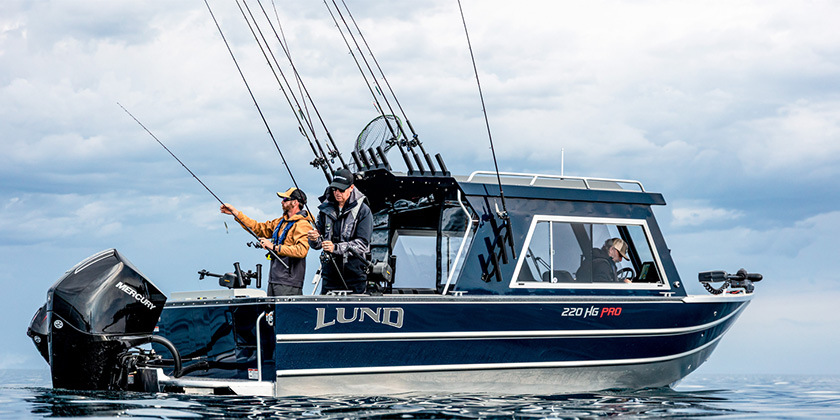
If your boat has a gaff it should be flown from the peak. If not, it should be flown from the flagstaff at the stern of the vessel. Normally this flagstaff is located at the center of the stern but, if rigging or an outboard motor do not permit this then the flagstaff should be located to starboard of the centerline. If the vessel is used for fishing, a flag staff located at the stern may interfere with the fishing gear. In this case the Canadian flag may be flown from a staff located amidships on the aft part of the cabin roof.
For sailboats, use a stern flagstaff if it does not obstruct the movement of the boom. You can fly the Canadian flag high up on the back stay of Marconi-rigged boats but no higher than 2/3rds of the way up. On gaff-rigged sailboats the Canadian flag should be flown at the peak of the aft gaff.
National Organizations like Sail Canada and CanBoat (Canadian Power & Sail Squadrons) have flags or burgees that indicate active membership. They should only be flown if the skipper is a paid-up member in good standing. The preferred location is the starboard spreader halyard. For vessels without this the bow staff should be used.
Next in order of importance will be yacht club and squadron pennants. These should be flow from the top of the main mast or the bow staff if there is no mast. No more than one of these should be flown at a time.
Association burgees like those from antique boat associations or cruising clubs should be flown from the spreader halyards with the more important on the starboard side and the one of lesser importance on the port side. Only one should be flown from each halyard and if you have more than one halyard on each spreader, the flag of more importance goes on the outer halyard.
It is clear that sailing vessels or powered vessels with a flag staff have the ability to fly more flags, pennants or burgees at any one time. Vessels with only a single stern flag staff and a bow flag staff should only fly the national flag from the stern and the most important flag pennant or burgee from the bow. If you are boating in the waters of another country you may fly the national flag of that country as a courtesy. Vessels without a mast should fly the courtesy flag from the bow staff replacing any other flag, pennant or burgee. With a mast the courtesy flag should be flown from the outer starboard spreader halyard and the flag it replaces should be moved to the inboard spreader halyard or to the port side if there are only single spreader halyards. The courtesy flag must be smaller than the vessels national flag and it must come down when the national flag does. It must not be flown when the vessel returns to its own country.
On special occasions like Canada Day or club sail pasts the ship may be “dressed” with a set of International Code Signal Flags that contains 40 alpha flags and numeric pennants. The set should be flown in a string from the bow to the mast head(s) and then down to the stern. No message needs to be spelled out and a suggested pattern would be to have two alpha flags followed by a numeric pennant, then two more alpha flags, another numeric pennant and so on.
If you are in distress and need assistance, then a Distress flag should be flown from the highest point or laid flat on the deck so it could be seen from the air. The international distress flag or cloth is an orange rectangle with a solid black square and a solid black ball on it.
Much of this information was taken from the CanBoat’s first edition of How to Fly Flags.
By John Gullick, currently CanBoat’s Manager of Government and Special Programs and has been an active recreational marine specialist and writer for over 50 years.
All articles are free for use to promote boating and water safety. Credit must be provided to CanBoat / NautiSavoir and author John Gullick.
Sign up for the CanBoat newsletter and visit CanBoat.ca to learn more about us.