Transport Canada accepts ABYC Electrical Standards for Electric and Hybrid Vessels
Transport Canada

Nov 8, 2022

Transport Canada has approved a policy accepting American Boat and Yacht Council (ABYC) electrical standards for electric and hybrid vessel compliance in Canada. This new Tier I Policy allows the marine industry to use alternative industry standards where no requirements currently exist within Canada’s regulatory framework. The policy went into effect on Oct 25, 2022.

This policy applies to vessels that are manufactured, constructed, converted, modified, altered or imported for use in Canada that are: pleasure craft less than 24 meters (78.7’); vessels other than pleasure craft not more than 24 meters; and fishing vessels not more than 24.4 (80’) meters and not more than 150 gross tonnage.

“This electric and hybrid vessel policy expands the already widely applied and accepted ABYC standards as the alternative to the existing Canadian construction requirements for small vessels set out in the Construction Standards for Small Vessels (TP 1332),” said ABYC Technical VP Craig Scholten. “Today, over 50% of the vessel Declarations of Conformities for Canadian compliance are using ABYC standards as the construction requirements in Canada.”

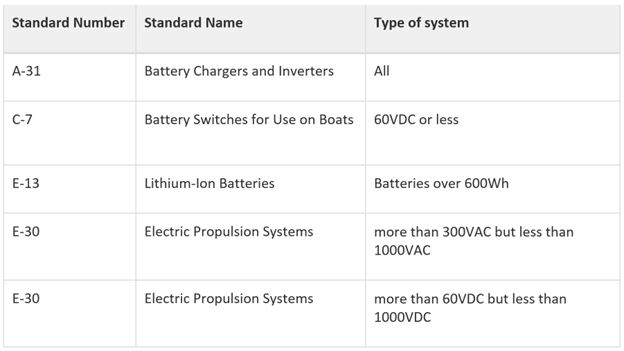
For more information on the policy, refer to Transport Canada’s Policy in its entirety. The included ABYC electrical standards are listed below:

About ABYC
Since 1954, the nonprofit American Boat & Yacht Council (ABYC) has developed safety standards for boat design, construction, equipage, repair and maintenance. The essential global source of marine industry technical information, ABYC’s product safety standards, credentialing, education, training, and other tools help members make boating safer.
Transport Canada Graph


Related Posts


Good Advice that You Can Share – The Art of Anchoring  

Unless a boat is secured, it will drift away. If it cannot be attached to something secure, such as a dock, piling, mooring buoy, tree, or boulder, it must be anchored. There is much more to anchoring than simply tossing the anchor over the side. 
 
An anchoring system has two parts: the anchor itself and the rode which connects the anchor to the boat. To be effective, an anchor must have good holding power, and the rode must be strong enough to withstand the strains that are put on it. 

Read More


Need to Catch up on News This Week?

Every Tuesday we publish a fresh Digest with informative articles pertaining to the Canadian boating and marine industry. Stay up to date with the latest products, research and industry developments.

Missed an Issue of Boating Industry Canada News Week? If you’re looking for a specific issue, or simply want to catch up on previous issues, check out our Boating Industry Canada News Week Archives.

Not signed up for News Week? Subscribe here.


Rayglass 2400 makes its Australian debut at the 2026 Sydney Boat Show

Rayglass Boats, a Brunswick Corporation (NYSE: BC) brand and a globally recognized designer and manufacturer of premium power boats, today announced that Australian boaters will get their first chance to see the Rayglass 2400 it in person for the first time. Queensland Marine Centre will bring the 2400 to the 2026 Sydney Boat Show, running 30 July – 2 August at Sydney Showgrounds, Sydney Olympic Park at Stand D104. The next generation 2700 will also be on display.

Read More


ePropulsion Enters Powered Kayak Fishing Market with Innovative kLite Electric Outboard

ePropulsion Americas, the global leader in marine electric propulsion systems and services, has announced that it is entering the powered kayak market with the all-new kLite 750 electric outboard. Building on the award-winning technology that shattered convention with the highly portable eLite, the kLite 750 is powerful, but contained in a lightweight and compact form factor ideal for recreational or fishing kayaks alike.

Read More