Volvo Penta and CMB.TECH partner on dual-fuel hydrogen engines
Oct 17, 2022
Building on a successful collaboration, Volvo Penta and CMB.TECH wish to announce a partnership agreement designed to accelerate the development of dual-fuel hydrogen-powered solutions for both on-land and at-sea applications. The strengthened collaboration will include joint projects ranging from pilots to small scale industrialization, providing increased access to this important technology for reducing greenhouse gas emissions.
CMB.TECH owns, operates, and designs large marine and industrial applications powered by hydrogen and ammonia – fuels that it both manufactures and supplies to its customers. Volvo Penta is a world-leading and global manufacturer of engines and complete power systems for boats, vessels, and industrial applications. The companies have worked together in pilot projects since 2017 successfully adapting Volvo Penta engines to run as a dual-fuel hydrogen and diesel solution via the conversion kit provided by CMB.TECH.
A low-carbon solution
The strengthened collaboration will create synergies aimed at leveraging the competences and product offerings of both companies – establishing dual-fuel hydrogen technology as a low-carbon interim solution before suitable zero-emissions alternatives become viable. It is an important step in Volvo Penta’s and CMB.TECH’s joint ambition to help accelerate their customers’ transition to net-zero emissions.
The partnership will cover pilot projects and small-scale industrialization of a hydrogen dual-fuel solution for selected customers.
“From the initial dual-fuel technology projects we have seen reductions of CO2 emissions up to 80%,” says Roy Campe, Chief Technology Officer at CMB.TECH and continues: “It is clear that the energy transition is a major challenge in many types of applications. With the dual-fuel technology we have been developing over the last few years, we can provide a cost-effective and robust solution for a variety of applications. We think there is huge potential in this solution for customers, both on-land and at-sea.”
The whole Volvo Group is working intensively to explore solutions to reduce – and ultimately eliminate – greenhouse gas emissions. Volvo Penta strives to team up with suppliers, partners, and customers to accelerate the journey into fossil-free fuels for both on land and at sea applications.
“The development in this area is moving fast and with this partnership we see a great opportunity to further explore and be part of increasing the use and availability of hydrogen solutions. I believe that this dual-fuel approach will appeal to many of our customers by its ease of installation, maintenance, and use. In addition, it will help accelerate our customers’ transition to more sustainable operations,” says Heléne Mellquist, President of Volvo Penta.
Dual-fuel technology
The dual-fuel solution’s main advantage is that it will reduce the emissions of greenhouse gases while at the same time provide a robust and reliable solution. And, if hydrogen is not available, the application continues to run on traditional fuel, safeguarding productivity.
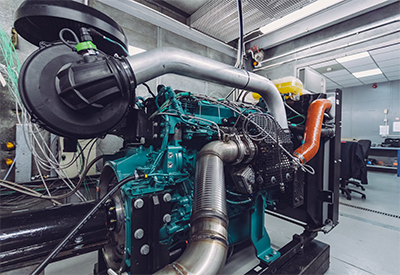
The design and testing of the hydrogen-injection system will take place at CMB.TECH’s Technology and Development Centre in Brentwood, UK. Here, Volvo Penta engines will be tested to optimize the hydrogen-diesel injection strategy for maximum reliability and emission savings.
“The simplicity of the dual fuel technology allows a quick introduction into many applications. The potential to decarbonize with green hydrogen is huge, but many applications require a fallback scenario of traditional fuel to maintain a viable business. With the dual fuel technology, your asset is future proof, even without a full coverage of a reliable hydrogen infrastructure today,” says Roy Campe, Chief Technology Officer of CMB.TECH.
“This solution is a valuable tool to have on our way to reaching our ambitious commitment to the Science Based Targets initiative where we aim to reach net-zero value chain emissions by 2040,” concludes Heléne. “There is no ‘one-solution-fits-all’ answer, which is why Volvo Penta is investing heavily in exploring a wide range of sustainable and bridging technologies – such as hybridization, electric drivelines, fuel cells and alternative fuels for combustion engines – giving customers the opportunity to find the technology that works best for their application.”